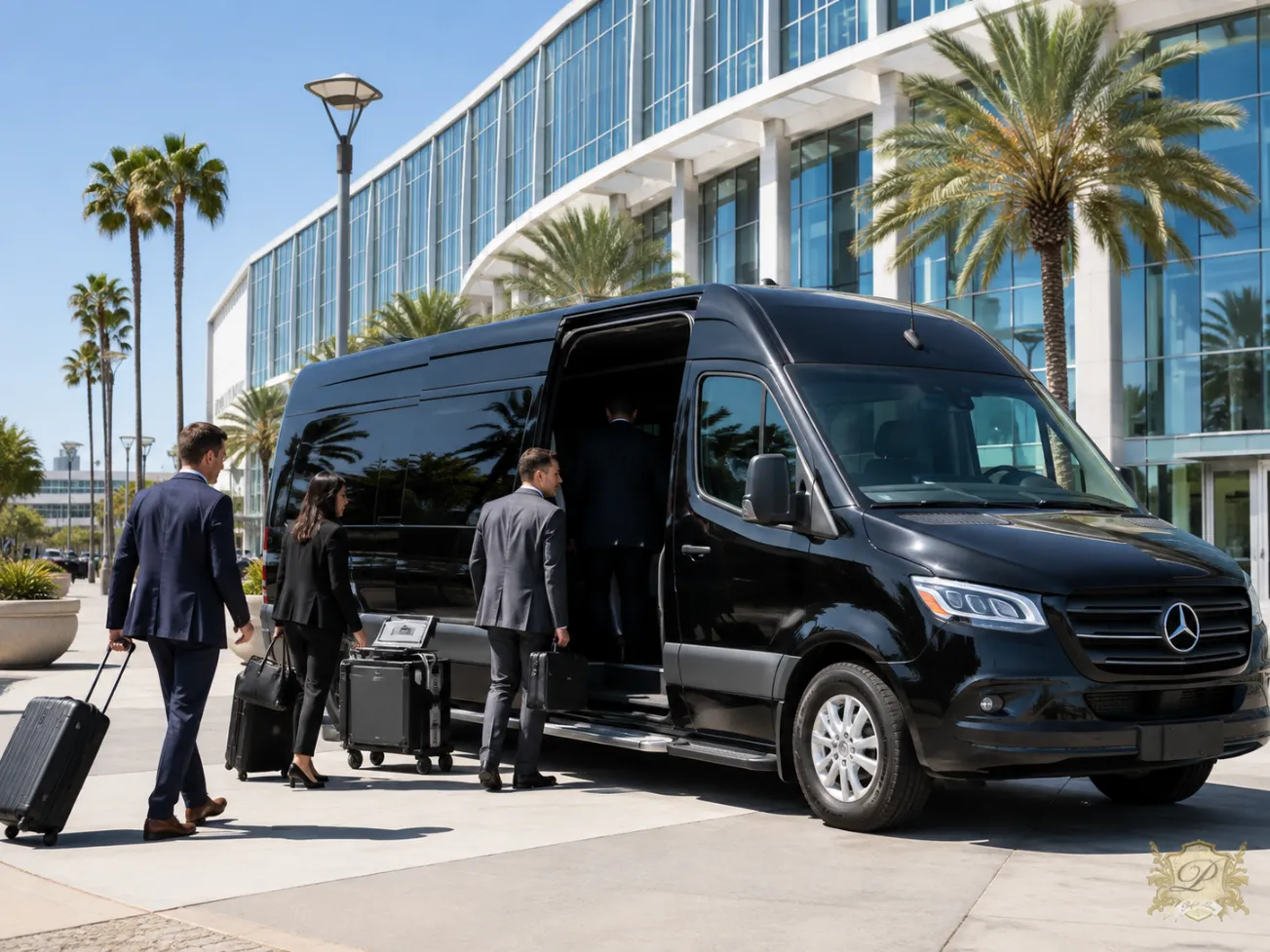
Conference & Trade Show Transportation for Corporate Travelers in Southern California
Southern California Corporate Event Transportation Guide
Corporate Transportation for Conferences and Trade Shows in Southern California
Successful corporate conference transportation involves much more than delivering attendees to a convention center. Business travelers may need airport pickups, hotel transfers, early-morning venue transportation, executive meetings, client dinners, off-site receptions, group departures, and return airport service within the same conference schedule.
Southern California makes that planning especially important because major conferences and trade shows can involve destinations across Anaheim, Ontario, Los Angeles, Long Beach, Orange County, Riverside County, and the Inland Empire. Employees may arrive through different airports, executives may follow separate meeting schedules, and large groups may need to move between hotels and venues at specific times.
Instead of treating every movement as an unrelated ride, companies can build executive and corporate transportation in Southern California around the complete conference itinerary. Doing so can make airport arrivals, hotel departures, client meetings, event sessions, dinners, and group transportation easier to coordinate.
Quick Answer
For conferences and trade shows, plan transportation around four movements: airport arrivals, hotel-to-venue transfers, transportation during the event, and post-event departures. Use executive sedans or SUVs when individual executives, speakers, or clients have separate schedules, and consider Mercedes Sprinters or other appropriately sized vehicles when larger employee groups need to travel together. Provide the transportation company with the conference dates, hotel locations, venue entrances, passenger groups, luggage, event schedule, airport information, and any dinners or off-site meetings before service begins.
Key Takeaways
- Build conference transportation around the entire event schedule, not only the convention-center address.
- Separate executives, VIPs, clients, speakers, and employee groups when their schedules or transportation requirements differ.
- Airport arrivals should be coordinated with flight information, luggage, hotel check-in, and the first required event time.
- Hotel-to-convention-center transportation requires realistic departure windows, especially when many attendees are traveling at the same time.
- Sedans and SUVs can support individual executive schedules, while Sprinters can simplify shared transportation for larger teams.
- Venue passenger-loading, staging, parking, and access procedures should be confirmed for the specific event rather than assumed.
- Trade show materials and attendee luggage can affect vehicle requirements even when the passenger count appears to fit a smaller vehicle.
Why Conference and Trade Show Transportation Is Different
Corporate conference transportation differs from an ordinary airport transfer because many passengers, schedules, and destinations can interact during the same event.
An executive may arrive one day before the employee group. A speaker may land at a different airport. Several employees may stay in one hotel while clients stay somewhere else. The main conference program may end in the afternoon, but the company may have a private dinner, product presentation, client reception, or internal leadership meeting later that evening.
The event may also create large surges in vehicle and pedestrian activity around the venue at opening and closing times. A theoretically short hotel transfer can take longer when hundreds or thousands of attendees are arriving or departing during the same window.
That is why companies should begin with a movement plan instead of simply reserving “a vehicle for the conference.”
1. Build the Conference Transportation Plan in Four Stages
A useful event transportation plan separates the trip into distinct phases. This prevents airport arrivals, hotel transfers, meetings, and departures from becoming one long unstructured reservation.
| Phase | Transportation Questions |
|---|---|
| 1. Arrival | Which airports? Which flights? Who travels to which hotels? How much luggage? |
| 2. Main Event | Which hotels feed into the venue? What are the required attendee arrival and departure windows? |
| 3. Off-Site Activities | Who attends client dinners, receptions, meetings, site visits, or private events? |
| 4. Departure | Which travelers go to which airports, on which flights, and from which hotel or venue? |
Once these four phases are documented, the planner can decide which passengers share transportation and which need separate executive arrangements.
2. Coordinate Airport Arrivals Before the Conference Begins
Conference transportation often begins before the event venue ever enters the itinerary. Employees, executives, clients, speakers, and exhibitors may arrive through Ontario International Airport (ONT), Los Angeles International Airport (LAX), John Wayne Airport (SNA), Long Beach Airport (LGB), or other Southern California airports.
Do not group travelers together simply because their scheduled landing times appear close. Passengers on different flights may have different baggage requirements, terminals, delays, and hotel destinations.
On the other hand, travelers arriving on the same flight or within a workable arrival window may be candidates for shared transportation when the destination, passenger count, luggage, and reservation timing allow it.
Build an Arrival Manifest
For each traveler or group, document the passenger name, mobile contact, airport, airline, flight number, scheduled arrival, hotel, luggage estimate, and whether the traveler has an event commitment immediately after landing.
If the executive team is still deciding which airport works best for the overall itinerary, review our comparison of corporate airport transportation at ONT, LAX, and SNA.
3. Executives and Speakers May Need Their Own Transportation Schedule
One common planning mistake is assuming that everyone attending the same conference should use the same transportation schedule.
Senior executives, keynote speakers, sales leaders, sponsors, board members, and important clients may have appointments outside the main conference agenda. An executive may leave the venue for a customer lunch while the rest of the team stays through the afternoon sessions. A speaker may need an earlier venue arrival. A company president may have an investor meeting after the trade-show floor closes.
These passengers can benefit from a dedicated sedan or SUV rather than being tied to the larger employee-group schedule.
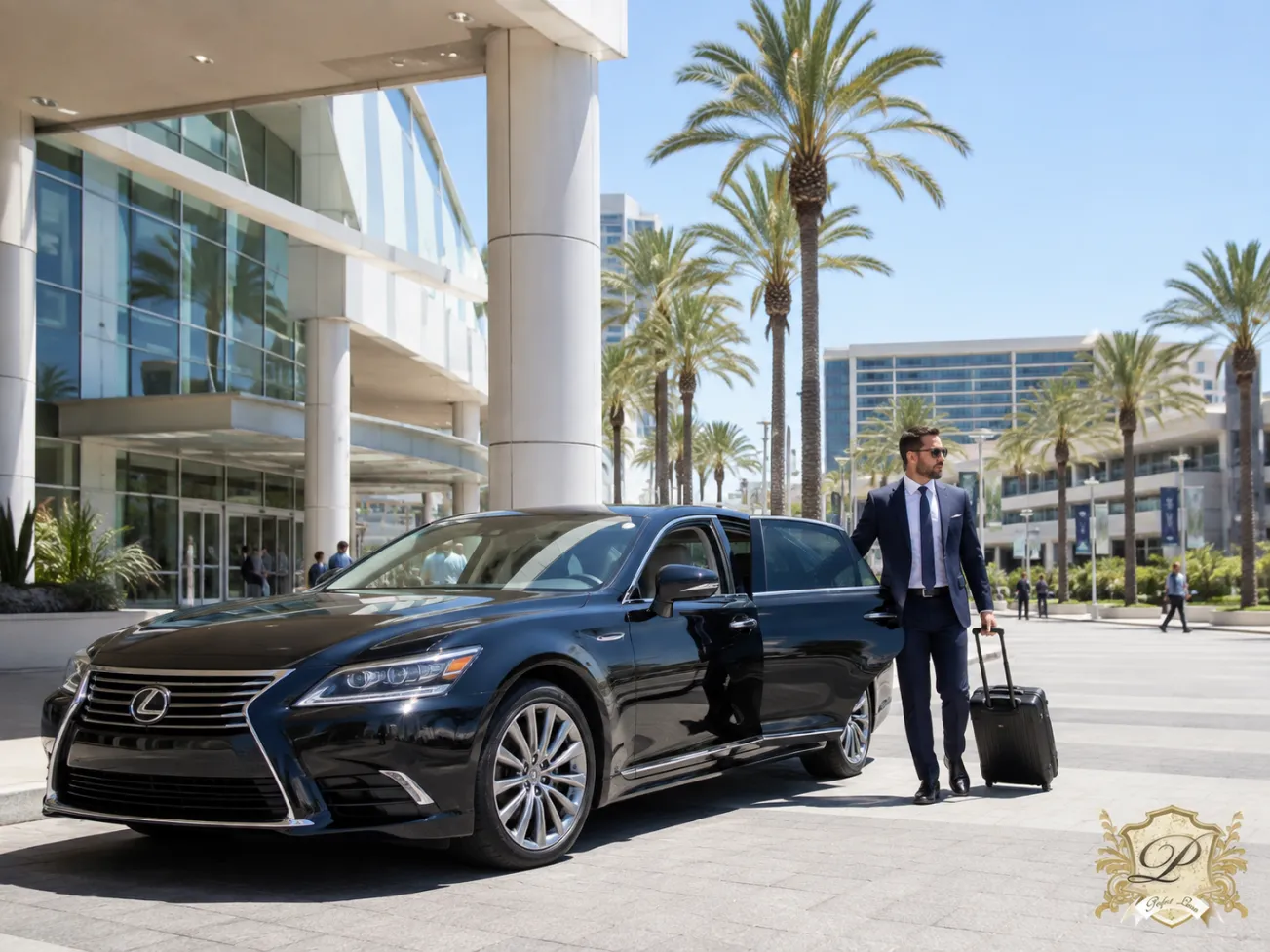
An executive sedan can be especially useful when one traveler has a separate airport arrival, hotel, meeting schedule, or evening commitment. The vehicle does not need to be the largest option in the fleet. It needs to support that executive’s specific movements.
The Perfect Limo and Sedan’s current fleet includes executive sedans as part of its broader Southern California chauffeured fleet.
4. Hotel-to-Convention-Center Transportation Needs Realistic Departure Windows
A hotel may look close to a convention center, but distance alone does not determine how early a group should leave.
The company needs to account for passengers gathering in the lobby, loading into the vehicle, event traffic, the designated passenger drop-off location, walking from the curb to registration or the meeting room, and any security or badge procedures required by the event.
If a conference session begins at 9:00 a.m., the transportation plan should be based on when attendees need to be inside the venue, not when the vehicle should reach the general property.
The same applies in the evening. Hundreds of attendees may leave during a similar period. A planner should establish where the company group will meet, which vehicle they are assigned to, and whether executives or clients have separate transportation.
Do Not Use the Session Start Time as the Transportation Arrival Time
If the attendee must register, obtain credentials, walk through a large convention facility, locate a meeting room, or prepare a booth before the public program begins, the required venue arrival may be substantially earlier than the session start time.
5. Separate Client and VIP Transportation When the Schedule Requires It
Conferences and trade shows frequently combine employee travel with client hospitality. The same event may include customers flying in for private meetings, senior partners attending a dinner, prospects visiting a booth, or executives meeting with industry contacts outside the main program.
Client transportation should therefore be planned according to the guest’s schedule rather than automatically attached to the employee shuttle.
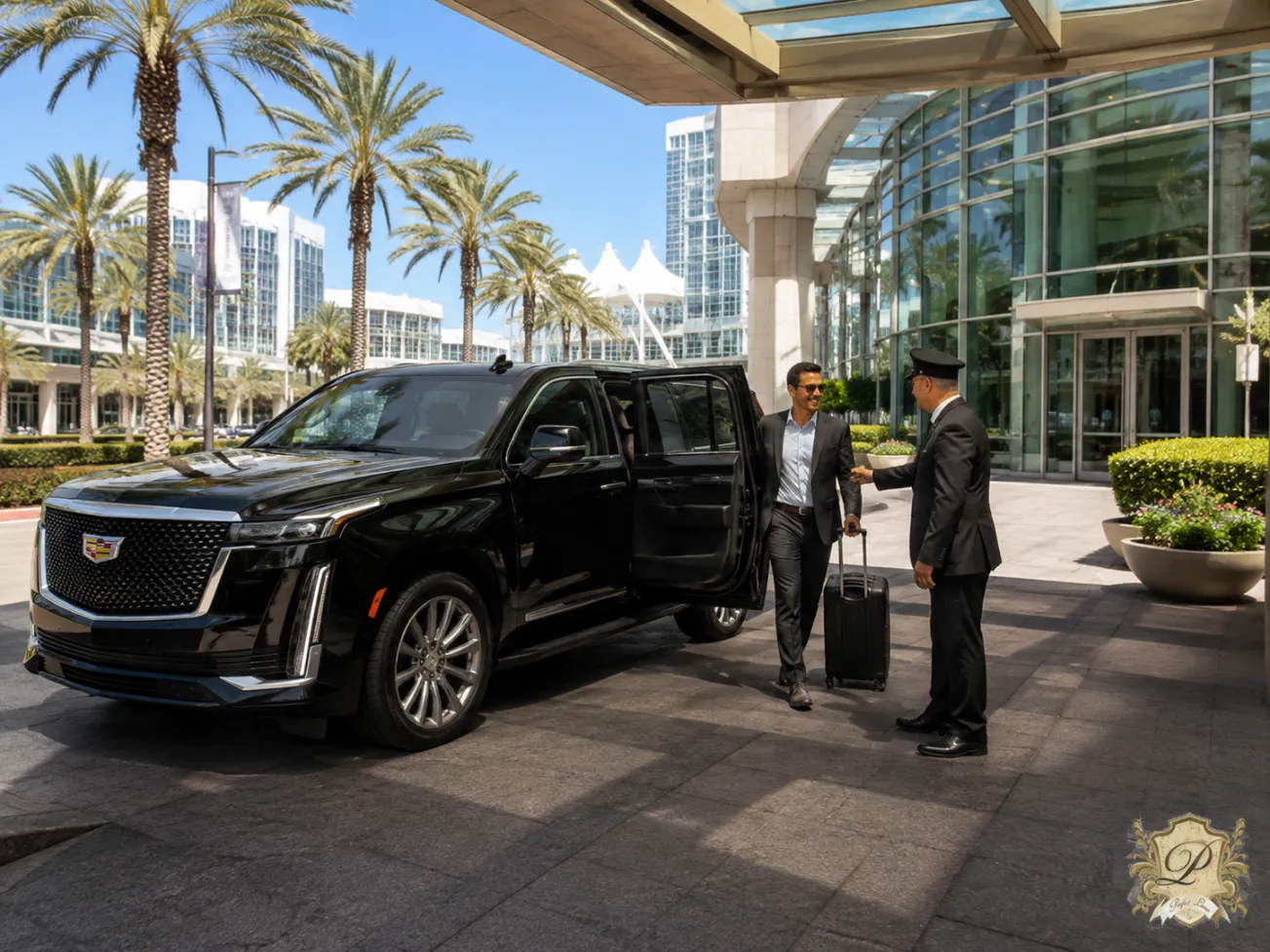
A visiting client may need airport pickup, hotel transportation, a private meeting at the conference hotel, a short visit to the expo floor, dinner at another location, and transportation back to the hotel. An executive SUV can make sense when several clients travel together or when airport luggage creates a larger capacity requirement.
The Perfect Limo and Sedan’s Cadillac Escalade Luxury SUV is one available executive vehicle option for trips requiring more passenger or luggage room than a sedan.
6. Use Group Transportation When the Team Shares the Same Schedule
The strongest use case for group conference transportation is a set of attendees who genuinely need to move together.
If ten employees are staying at the same hotel, attending the same morning program, leaving at the same time, and returning to the same destination, assigning several unrelated vehicles can create unnecessary coordination work.
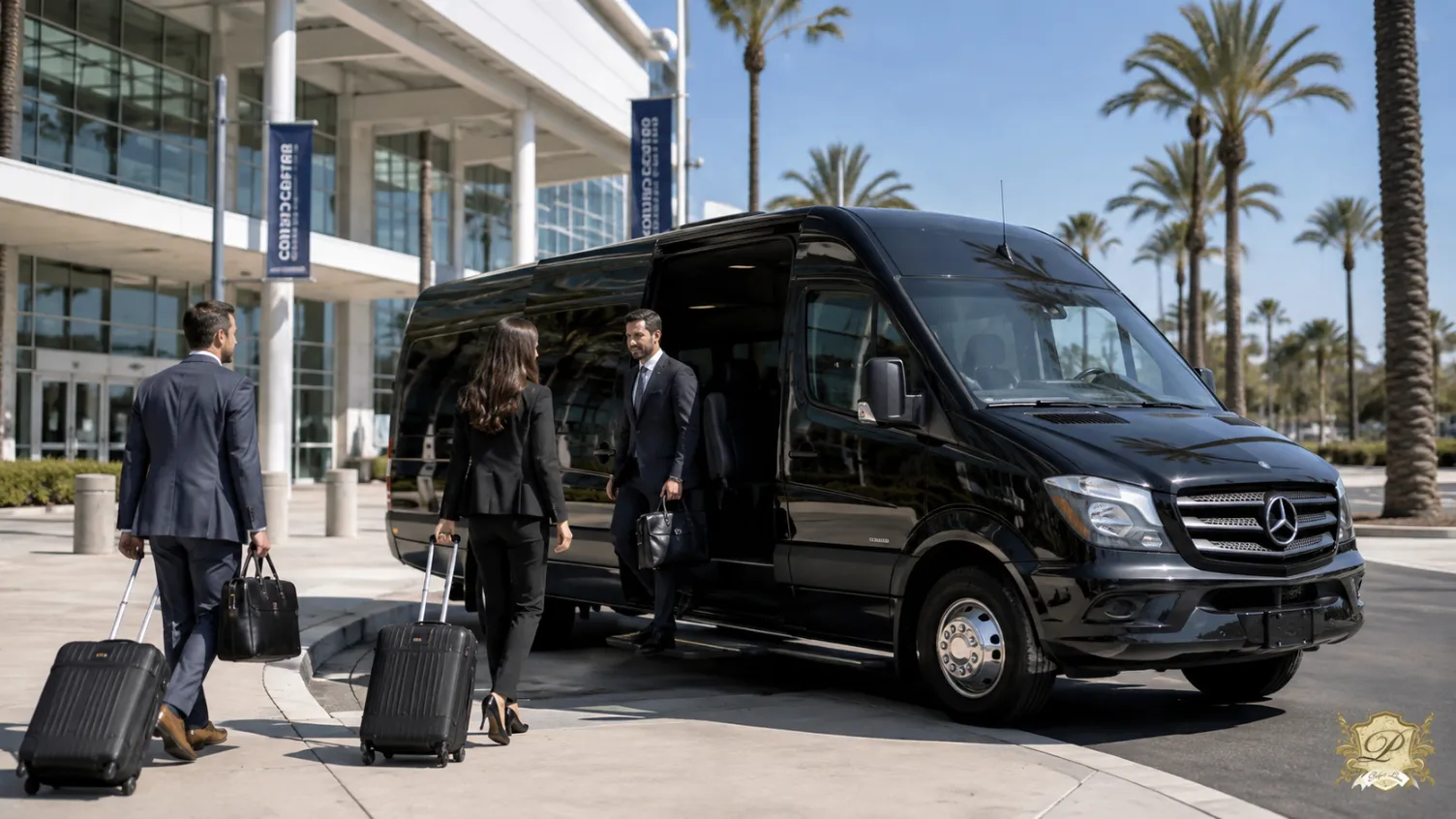
A Mercedes Sprinter or another appropriately sized group vehicle can allow those attendees to depart and arrive together. The transportation coordinator then manages one primary movement rather than several independent vehicle assignments.
This arrangement can be particularly useful for hotel-to-venue transfers, conference dinners, company receptions, site visits, corporate retreats connected to the event, and airport transportation when travelers have compatible schedules.
Several vehicles may still be the better choice if attendees have different flights, hotels, client appointments, or departure times. Group transportation should reduce complexity, not force people with different schedules into one movement plan.
Companies deciding between vehicle categories can use our guide comparing an executive sedan vs SUV vs Sprinter for corporate transportation.
7. Trade Show Materials Can Change the Vehicle Requirement
Passenger capacity is only one part of planning transportation for trade-show exhibitors.
Sales teams and exhibitors may travel with roll-up displays, product samples, literature, presentation cases, demonstration equipment, laptop bags, garment bags, or other materials in addition to personal luggage.
A vehicle that appears appropriate for the passenger count can become impractical when the cargo requirement is added. This is particularly important during airport transfers because every traveler may also have a suitcase and carry-on.
Tell the transportation provider exactly what passengers expect to bring. Do not simply say “six people” if those six people also have several days of luggage and multiple trade-show cases.
Important Distinction: Attendee Transportation Is Not Freight Logistics
Professional passenger transportation should not be assumed to replace an event’s freight, drayage, booth-shipping, or material-handling process. Large exhibit structures, pallets, freight cases, and commercial booth shipments should be handled according to the event organizer and venue’s exhibitor logistics instructions.
8. Plan Off-Site Meetings, Client Dinners, and Receptions Separately
The conference venue is rarely the only destination on a corporate event itinerary.
Teams may schedule customer dinners, product launches, networking receptions, investor meetings, site visits, internal strategy sessions, or private hospitality events elsewhere in the city.
These movements should be listed separately because the passenger group may be different from the main conference group. Twenty employees may attend the trade show, while only six sales leaders and two clients attend dinner. Three executives may leave the venue earlier for a private meeting while everyone else stays through closing.
Building these movements into the transportation plan avoids last-minute confusion about which vehicle is serving which group.
If the event day includes several offices, hotels, meeting venues, restaurants, or airports, our guide to multi-stop executive transportation provides a detailed framework for sequencing appointments and protecting fixed deadlines.
9. Southern California Conference Venues Require Location-Specific Planning
Conference transportation should be planned around the actual venue rather than a generic city destination. Major Southern California event markets include Anaheim, Los Angeles, Ontario, and Long Beach, each with different surrounding hotels, streets, airports, and traffic patterns.
Anaheim Convention Center
The City of Anaheim describes the Anaheim Convention Center as the largest convention center on the West Coast and a venue for major meetings, conventions, and shows. Companies attending events there may have participants staying throughout the Anaheim Resort area as well as executives or clients arriving from SNA, LAX, ONT, or nearby business locations.
Los Angeles Convention Center
Downtown Los Angeles conferences may involve hotel pickups, event traffic, executive meetings elsewhere in the city, and LAX transfers. Planners should identify the correct venue access and passenger-loading instructions supplied for the event rather than assuming a vehicle can wait at any entrance.
Ontario Convention Center
Ontario can be particularly relevant for companies with Inland Empire operations or guests using ONT. A conference itinerary may combine the convention center with nearby hotels, company offices, client dinners, airport transportation, and meetings elsewhere in San Bernardino or Riverside counties.
Long Beach Convention and Entertainment Center
Long Beach events can create another set of airport and hotel decisions, including possible transportation involving Long Beach Airport or LAX. Corporate groups should again confirm event-specific drop-off, pickup, staging, and access instructions before the service date.
Regardless of venue, planners should verify current event instructions because passenger-loading procedures can differ by show, entrance, street closure, security plan, or facility operation.
10. Build Traffic Buffer Into Every Important Event Movement
Conference attendees often travel at the same times as thousands of other visitors. Opening sessions, expo-floor closing times, keynote events, receptions, sporting events, concerts, and normal commuter traffic can all influence local conditions.
No transportation company can guarantee that Southern California traffic will move according to an ideal estimate. The transportation plan should therefore protect the appointments that matter most.
California travelers and event planners can use Caltrans QuickMap to review current state-highway conditions such as traffic speeds, incidents, lane closures, and related roadway information before major movements.
The buffer should reflect the consequence of lateness. An informal team dinner may tolerate a smaller margin than a keynote presentation, airport departure, private client meeting, or executive speaking engagement.
11. Use One Transportation Coordinator for the Corporate Group
Conferences generate frequent changes. A flight moves. A dinner guest is added. Two employees decide to stay longer at the expo. A client meeting changes hotels. A speaker needs to leave earlier than expected.
The transportation plan becomes harder to manage when several employees independently send conflicting changes to the provider.
Designate one transportation coordinator or a small authorized planning team. This may be an executive assistant, office manager, corporate travel coordinator, event planner, meeting planner, or another designated contact.
The coordinator should maintain the master passenger list and movement schedule and know which travelers belong to each vehicle assignment.
12. Compare Transportation Quotes Using the Same Conference Plan
Conference transportation quotes become difficult to compare when each provider receives different information.
One company may receive a request for “transportation for 12 people.” Another may receive the hotel, convention center, service times, airport transfers, luggage count, dinner schedule, and executive vehicle requirements. Those companies are not pricing the same assignment.
Prepare one movement brief and send substantially the same information to each provider. Then compare vehicle recommendations, service windows, number of vehicles, group strategy, included charges, schedule-change policies, and the assumptions behind the quote.
Our existing guide to comparing corporate event transportation quotes covers this pricing and proposal process in greater detail, while this article focuses on conference and trade-show operations.
13. Choose a Transportation Company That Understands Event Logistics
Conference transportation can expose weaknesses in a reservation process quickly because there may be several passengers, multiple vehicles, airport information, strict session times, and event-specific access requirements.
A provider should ask enough questions to understand the assignment. If a company can quote a complicated conference immediately without asking about hotels, flights, passenger groups, luggage, venue schedule, or off-site events, verify whether the quote actually reflects the transportation requirement.
Businesses should also verify the provider’s regulatory standing and understand the written reservation terms before confirming service.
Our guide on how to choose a corporate transportation company explains how to review operating authority, insurance status, fleet suitability, airport processes, quotes, communication, and other provider-selection factors.
Corporate Conference Transportation Planning Checklist
| Planning Item | Information to Collect |
|---|---|
| Conference | Venue, event dates, attendee arrival targets, program start and finish times |
| Hotels | Every hotel used by employees, executives, clients, or speakers |
| Airports | Airport, airline, flight number, passenger and arrival/departure information |
| Passenger groups | Employees, executives, clients, speakers and other groups that travel on different schedules |
| Luggage | Suitcases, carry-ons and other personal travel items |
| Trade show materials | Presentation cases, samples or small attendee-carried materials that affect vehicle capacity |
| Venue access | Current passenger pickup/drop-off and staging instructions supplied by the event or venue |
| Off-site events | Restaurants, client meetings, receptions, hotels and private event addresses |
| Vehicles | Sedans, SUVs, Sprinters or mixed fleet according to each passenger group |
| Coordinator | Primary company contact authorized to manage schedule updates |
Example: A Three-Day Southern California Trade Show Transportation Plan
A transportation plan becomes easier to understand when movements are separated by purpose. The example below is not a fixed service schedule. It illustrates how a company could organize the information before requesting transportation.
| Event Stage | Transportation Requirement |
|---|---|
| Day 0: Executive arrival | Executive airport transfer to hotel by sedan or SUV |
| Day 0: Employee arrivals | Separate airport movements organized according to compatible flights and hotel destination |
| Day 1: Opening morning | Group hotel-to-convention-center transportation with protected arrival buffer |
| Day 1: Client meeting | Executive or client SUV departs separately from employee group |
| Day 1: Company dinner | Vehicles assigned according to dinner attendee count and return schedule |
| Day 2: Conference program | Repeat group movement adjusted to actual first-day experience and current event timing |
| Day 3: Departure | Airport transfers grouped by airport, flight timing, passenger count and luggage |
This structure makes it much easier to determine which movements need a private sedan, which need an SUV, which can use a Sprinter, and where different schedules should remain separate.
Coordinate the Conference Before the First Traveler Arrives
The Perfect Limo and Sedan provides corporate and executive transportation for conferences, conventions, meetings, client events, airport transfers, business groups, and multi-stop itineraries throughout Southern California.
Available vehicle categories include executive sedans, luxury SUVs, Mercedes-Benz Sprinters, and other chauffeured options that can be matched to individual executives, visiting clients, and corporate groups.
Planning transportation for an upcoming conference or trade show? Review our corporate limo and sedan service or call 800-951-3017 with your event dates, venue, hotels, airports, passenger groups, and transportation schedule.
Frequently Asked Questions About Corporate Conference Transportation
How should a company plan transportation for a conference?
Separate the transportation plan into airport arrivals, hotel-to-venue transfers, movements during the conference, off-site meetings or dinners, and final airport departures. Then divide passengers according to shared schedules, hotels, airports, luggage, and vehicle requirements.
What is the best vehicle for conference transportation?
It depends on the passenger group. A sedan may suit an individual executive or speaker, an SUV can support several clients or additional luggage, and a Mercedes Sprinter can help a larger employee group travel together. Complex events may require a mixed fleet.
Should executives use the same transportation as the employee group?
Not necessarily. Executives, speakers, clients, and VIP guests may have separate meetings, airport schedules, dinners, or required arrival times. Dedicated sedan or SUV transportation can be more practical when their itinerary differs from the main group.
Is a Sprinter good for trade show transportation?
A Sprinter can be useful when a corporate group shares the same hotel, conference venue, airport, dinner, or meeting schedule. Confirm the exact passenger and luggage requirements because trade show attendees may also be carrying presentation materials or equipment.
How early should a corporate group leave the hotel for a convention?
There is no universal departure time. Consider passenger loading, current traffic, event congestion, venue drop-off procedures, walking distance inside the facility, registration or security requirements, and when attendees actually need to be inside the event rather than only at the property.
Can conference transportation include airport transfers?
Yes. Airport arrivals and departures can be incorporated into the wider conference plan. Provide each traveler’s airport, airline, flight number, hotel, passenger count, luggage, and any event commitments connected to the flight.
Can a transportation company move attendees to client dinners and off-site events?
Yes, when those movements are part of the reservation. Provide the restaurant, meeting, reception or event address, passenger count, required arrival time, expected departure, and whether those passengers are different from the main conference group.
What information is needed for a conference transportation quote?
Provide the event dates, venue, hotels, airports and flight information, passenger groups, luggage, attendee-carried materials, daily arrival and departure windows, off-site events, executive transportation requirements, preferred vehicles, and the primary event transportation contact.
Final Takeaway
Effective corporate conference transportation begins by identifying who needs to move, when they need to move, and whether those passengers actually share the same itinerary.
Airport arrivals should be coordinated with hotels and event schedules. Executives, clients, and speakers may need separate sedan or SUV transportation. Employee groups may benefit from a Sprinter when they share the same conference schedule. Trade show luggage and materials should be considered before the vehicle is selected.
Venue access, event traffic, registration time, client dinners, off-site meetings, and return airport transfers should also be part of the transportation plan rather than handled as last-minute additions.
For conferences and trade shows in Southern California, the goal is not simply to have vehicles available. It is to create a coordinated movement plan that supports the event schedule from the first airport arrival through the final departure.