
Corporate Transportation Costs in Southern California: What Businesses Should Know
Southern California Corporate Transportation Guide
How Much Does Corporate Transportation Cost in Southern California?
Corporate transportation cost in Southern California does not have one standard price because a business may be booking anything from a single executive sedan transfer to a multi-vehicle corporate event. Vehicle type, distance, service duration, pickup location, airports, number of stops, passenger count, luggage, waiting time, and the structure of the itinerary can all affect the final quote.
A company arranging one executive pickup from Ontario International Airport has a very different transportation requirement from a company moving twelve employees between LAX, a hotel, a conference venue, and an evening dinner. Comparing those trips using one advertised hourly number would provide very little useful information.
The better way to estimate corporate transportation cost is to understand what the transportation company needs to price the trip accurately. This guide explains the major cost factors, where companies can control unnecessary expense, and how to compare transportation options without sacrificing the requirements of the business itinerary.
Quick Answer
Corporate transportation cost in Southern California depends primarily on the vehicle, service duration, mileage or route, number of stops, airport or venue requirements, passenger count, luggage, and whether the trip is a simple transfer or a longer reserved itinerary. A sedan for one executive will normally be priced differently from a Cadillac Escalade for several passengers or a Mercedes Sprinter for a corporate group. For an accurate comparison, request quotes using the same complete itinerary rather than comparing a single advertised rate.
Key Takeaways
- There is no meaningful single price for corporate transportation because business itineraries vary significantly.
- Vehicle type is one of the largest pricing variables. A luxury sedan, executive SUV, and Mercedes Sprinter serve different passenger and capacity requirements.
- Point-to-point transfers and multi-hour or multi-stop transportation may be priced differently.
- Airport fees, tolls, parking, waiting time, overtime, minimum service periods, and other trip-specific charges should be clarified before booking.
- A larger vehicle can sometimes make better financial sense than several separate sedans when a corporate group needs to travel together.
- The best quote is not automatically the lowest number. Businesses should compare exactly what transportation, vehicle, timing, and charges are included.
Why Corporate Transportation Prices Vary So Much
Corporate transportation is not one standardized product. Even two reservations involving the same vehicle can require different amounts of time, mileage, waiting, airport access, parking, route planning, or additional stops.
Consider two executives who both reserve a luxury sedan. The first traveler may need a straightforward transfer from an office in Corona to Ontario International Airport. The second may need transportation from a hotel to three meetings across Riverside and Orange counties, followed by dinner and a return to the hotel. Although the vehicle is identical, the service requirement is not.
The same principle applies to SUVs and group vehicles. A Cadillac Escalade transporting several passengers from an airport to one hotel should not automatically be expected to cost the same as an Escalade reserved through an entire afternoon of meetings.
This is why companies considering corporate limo and sedan service in Southern California should provide the complete itinerary when requesting pricing. The transportation provider can then evaluate the actual service instead of estimating from incomplete information.
What Factors Affect Corporate Transportation Cost?
The exact pricing structure depends on the company and reservation, but most corporate transportation quotes are influenced by several recurring factors.
| Cost Factor | Why It Matters |
|---|---|
| Vehicle type | Sedans, SUVs, limousines, and Sprinters have different operating costs and capacities. |
| Trip distance | Longer routes require more vehicle and chauffeur time. |
| Service duration | A transfer is different from reserving a vehicle for several hours. |
| Number of stops | Multiple offices, hotels, venues, and restaurants create a more involved itinerary. |
| Passenger count | More passengers may require an SUV, Sprinter, or multiple vehicles. |
| Luggage | Airport groups may need a larger vehicle even when the passenger count fits a smaller one. |
| Airport or venue access | Airport fees, parking, staging, terminal procedures, or venue access can affect the reservation. |
| Waiting or standby time | Keeping a vehicle and chauffeur available between meetings can affect total service time. |
| Date and schedule | Availability and scheduling requirements can differ by date and time. |
1. Vehicle Type Can Significantly Affect the Quote
Vehicle choice is one of the clearest factors affecting corporate transportation cost. A business should select a vehicle based on actual passenger and luggage requirements instead of automatically requesting the largest or most formal vehicle available.
A luxury sedan is often appropriate for a single executive or a small party. A Cadillac Escalade provides additional passenger and cargo space. A Mercedes Sprinter can accommodate a larger group and may reduce the need to reserve several individual vehicles.
The Perfect Limo and Sedan’s current chauffeured vehicle fleet includes luxury sedans, SUVs, limousines, and several Mercedes-Benz Sprinter configurations. The right vehicle depends on how many people are traveling, how much luggage they have, and how the vehicle will be used during the trip.
Do Not Pay for Capacity You Do Not Need
If one executive with a normal amount of luggage can travel comfortably in a sedan, reserving a much larger group vehicle may provide little financial or operational benefit. The opposite is also true: choosing vehicles that are too small and then requiring several of them can increase complexity and potentially increase the total transportation spend.

2. Point-to-Point Transportation vs Reserved Hourly Service
One of the most important questions is whether the business needs a simple transfer or wants the vehicle available through a longer portion of the day.
Point-to-Point Transportation
Point-to-point service generally describes transportation from one primary pickup location to one destination. Common corporate examples include an office-to-airport transfer, airport-to-hotel trip, hotel-to-office transfer, or transportation from a company headquarters to a dinner venue.
When the requirement is straightforward, this type of reservation can be simpler to quote because the basic movement is already defined.
Hourly or Extended Service
A business may instead need a chauffeur and vehicle available through several meetings, client visits, site inspections, lunches, or other scheduled stops. In that scenario, an extended or hourly reservation may better reflect the actual service requirement.
The important point is that companies should not compare the price of a basic transfer with a quote for several hours of dedicated transportation as if they are equivalent products. They solve different problems.
Companies that primarily need transportation for one or a few executives can also review our guide comparing executive car service vs limo service for business travel to determine whether a sedan, SUV, or larger chauffeured vehicle better fits the trip before requesting a quote.
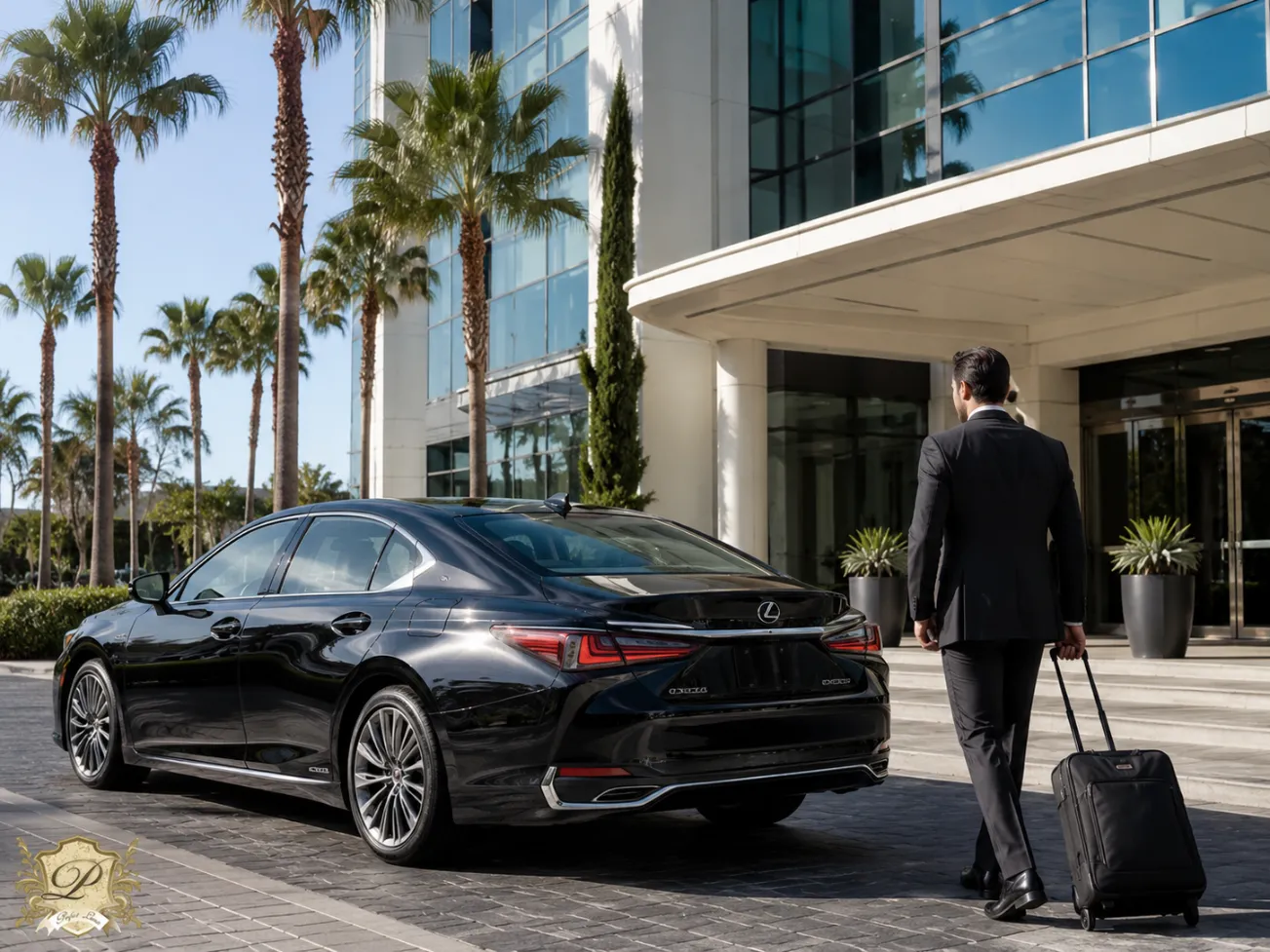
3. Airport Transportation Has Its Own Cost Variables
Corporate airport transportation can involve more than mileage between the terminal and destination. The reservation may also need to account for flight arrival information, airport pickup procedures, waiting time, parking or airport-related charges, luggage, and where the passenger needs to travel after leaving the airport.
Southern California companies commonly arrange travel through airports such as Ontario International Airport (ONT), Los Angeles International Airport (LAX), John Wayne Airport (SNA), and Long Beach Airport (LGB). Each airport and itinerary can create different transportation requirements.
For example, an ONT-to-Corona executive transfer is fundamentally different from an LAX arrival followed by travel deep into the Inland Empire. The second trip may involve substantially more road time even before any additional meetings or hotel stops are added.
This is why airport name, flight details, passenger count, luggage, pickup preference, and final destination should all be included when requesting a corporate transportation quote.
4. Corporate Group Transportation Should Be Priced as a System
Passenger count changes the economics of corporate transportation. When several employees need to travel to the same destination, the cheapest individual vehicle does not automatically create the lowest overall cost.
Suppose eight colleagues need transportation from an airport to a hotel and later to the same conference venue. One option may involve several sedans or SUVs. Another may involve one appropriately sized Mercedes Sprinter. The larger vehicle can have a higher individual reservation price, but the business should compare it with the combined cost and coordination requirements of several smaller vehicles.
Group transportation can also reduce the chance of employees reaching a meeting or venue at significantly different times because their separate vehicles took different routes or departed at different moments.
The Perfect Limo and Sedan currently offers multiple Mercedes-Benz Sprinter configurations, including executive and limousine models. One of its Mercedes-Benz Sprinter Executive Limousine options is listed for 10 to 12 passengers, making this type of vehicle relevant when companies want a larger business group to remain together.

5. Multiple Stops Can Change Corporate Transportation Cost
Corporate schedules are frequently more complicated than one pickup and one destination. Executives may move from an airport to a hotel, continue to a headquarters, visit a client, attend dinner, and then return to the hotel.
Every additional stop can affect routing, service duration, waiting requirements, and the chauffeur’s overall schedule. A business requesting pricing should therefore disclose the full itinerary rather than requesting a quote for the first segment and adding several unplanned stops later.
This is especially important in Southern California because appointments can be spread across Riverside County, San Bernardino County, Orange County, and Los Angeles County. The geographic distance between stops can have a major effect on how long the vehicle is required.
A structured itinerary also helps determine whether individual transfers or a dedicated vehicle arrangement is more practical. Businesses with complex executive schedules can review our broader Southern California executive transportation guide when planning multi-city business travel.
6. Ask What Is Included in the Corporate Transportation Quote
Two corporate transportation quotes can show similar base prices but produce different final totals if one excludes charges that the other already includes. Businesses should therefore ask for a clear written explanation of the quote before making a decision.
The California Public Utilities Commission’s passenger-carrier consumer information provides guidance for consumers using limousine and other regulated passenger transportation services. For corporate buyers, obtaining clear written reservation terms is particularly useful when several transportation companies are being compared.
Charges or Policies Worth Clarifying
- Base transportation charge
- Hourly minimums, when applicable
- Additional or overtime hours
- Waiting-time policy
- Airport-related fees
- Parking charges
- Tolls
- Gratuity or service charges
- Additional-stop charges, if applicable
- Cancellation or schedule-change policy
- Any other trip-specific fees
Not every reservation will include every item above. The purpose of asking is to understand what the quoted amount represents so that competing proposals can be evaluated on the same basis.
7. Does Professional Corporate Transportation Cost More Than Rideshare?
A short rideshare trip can certainly cost less than reserving professional chauffeured transportation. They are also different transportation models, so a meaningful comparison requires looking at what the business actually needs.
If one employee needs a flexible trip from a hotel to a nearby restaurant, rideshare may be the more economical and practical choice. If a company is coordinating airport transportation for a visiting executive, a client presentation, several fixed meetings, or an entire team, the calculation changes.
Companies evaluating that broader decision can read our comparison of corporate transportation vs rideshare for business travel. The decision should account for coordination, vehicle requirements, schedule importance, group size, and passenger experience in addition to the first displayed fare.
8. How Businesses Can Control Corporate Transportation Cost
Cost control does not necessarily mean selecting the least expensive vehicle for every trip. It means designing the transportation plan so that the company is not paying for unnecessary capacity, unnecessary vehicles, or avoidable schedule complexity.
Match the Vehicle to the Passenger Count
Use a sedan when a sedan genuinely fits the passenger and luggage requirement. Move to an SUV or Sprinter when the additional capacity provides an operational benefit.
Consolidate Travelers When It Makes Sense
If several employees have the same origin, destination, and schedule, compare the cost of one appropriately sized group vehicle with several separate cars.
Finalize the Itinerary Before Requesting Quotes
A quote based on incomplete information is difficult to compare. Provide the stops, approximate timing, passenger count, airports, hotels, meetings, venues, luggage, and expected service window as early as possible.
Separate Critical Travel From Incidental Travel
A company does not need to use the same transportation method for every employee movement. It can reserve chauffeured transportation for executives, airports, clients, groups, and time-sensitive itineraries while using simpler transportation solutions for low-impact incidental trips.
Avoid Comparing Different Service Levels
If one proposal includes an SUV with standby time and another covers only a direct sedan transfer, the lower quote does not necessarily represent better value. Make sure the providers are pricing the same transportation requirement.
9. How to Compare Corporate Transportation Quotes
Once the itinerary is established, ask each provider to quote the same scope. This makes differences in vehicle recommendation, pricing structure, and included services much easier to identify.
| What to Compare | Question to Ask |
|---|---|
| Vehicle | What exact vehicle type or category is being quoted? |
| Passenger and luggage capacity | Will this vehicle accommodate the entire party and luggage comfortably? |
| Service period | Is the quote point-to-point, hourly, or based on another service structure? |
| Included charges | What is included and what may be added later? |
| Extra time | What happens if a meeting runs longer than expected? |
| Schedule changes | What is the policy if the itinerary changes? |
| Licensing and insurance | Does the carrier hold the required operating authority and insurance? |
California businesses can also review the California Public Utilities Commission’s Charter-Party Carrier information when learning about the regulatory framework governing prearranged passenger transportation.
For a more detailed event-specific comparison, our guide to comparing corporate event transportation quotes explains how planners can prepare one-day multi-stop event requirements, vehicle needs, service windows, and quote details before selecting a provider.
10. Example Corporate Transportation Scenarios
These examples do not represent fixed prices. They illustrate why different corporate trips need different quotes.
| Scenario | Likely Cost Drivers |
|---|---|
| One executive from ONT to a Corona office | Sedan, route distance, airport-related requirements, pickup details |
| Three clients from LAX to an Orange County hotel | SUV capacity, luggage, airport procedures, distance and traffic time |
| Executive with four meetings across three cities | Vehicle type, total service period, waiting time, number of stops and mileage |
| Ten employees traveling to a conference | Sprinter or group vehicle, luggage, service duration, hotel and venue stops |
| Corporate dinner with several pickup locations | Number of vehicles, pickup sequence, service window, waiting and return transportation |
The lesson is simple: there is no responsible way to estimate corporate transportation cost from the words “business trip” alone. The quote becomes meaningful only after the transportation requirement is defined.
Request Corporate Transportation Pricing for Your Actual Itinerary
The Perfect Limo and Sedan provides corporate and executive transportation throughout Southern California using luxury sedans, executive SUVs, limousines, Mercedes Sprinters, and other chauffeured vehicles for different business requirements.
For the most useful quote, provide your travel date, pickup locations, destinations, approximate schedule, passenger count, luggage requirements, airport or flight information, planned stops, and preferred vehicle type if known.
Need pricing for an upcoming business trip? Review our corporate limo and sedan service or call 800-951-3017 with your itinerary to discuss vehicle options, pricing, and availability.
Frequently Asked Questions About Corporate Transportation Cost
How much does corporate transportation cost in Southern California?
There is no single standard price. Corporate transportation cost depends on vehicle type, route, service duration, number of stops, passenger count, luggage, airport or venue requirements, waiting time, and other reservation details. A complete itinerary is normally needed for an accurate quote.
Is a corporate sedan cheaper than an SUV?
Vehicle pricing can vary, and a sedan will generally represent a different service category from a larger executive SUV. Businesses should choose according to passenger and luggage requirements rather than price alone. An undersized vehicle can create the need for an additional car.
Is a Mercedes Sprinter cheaper than booking several executive cars?
It can be more practical for some groups, but the answer depends on passenger count, luggage, service duration, route, and the number of smaller vehicles that would otherwise be required. Companies should compare the complete group transportation plan rather than the price of one vehicle.
Does airport transportation cost more?
Airport reservations can have additional factors such as airport-related fees, parking, waiting, flight timing, terminal procedures, distance, and luggage. Whether the total is higher depends on the specific airport and itinerary.
Is hourly corporate car service better than point-to-point transportation?
It depends on the itinerary. Point-to-point transportation can work well for straightforward transfers. An extended or hourly reservation may make more sense when an executive has several meetings, client visits, meals, or other stops during a defined service window.
What information do I need to get an accurate corporate transportation quote?
Provide the travel date, pickup location, destinations, approximate pickup and drop-off times, passenger count, luggage needs, flight information when relevant, planned stops, desired vehicle type, and how long the vehicle may be needed.
Should a business choose the lowest corporate transportation quote?
Not automatically. Confirm that each quote covers the same vehicle category, service period, itinerary, included charges, passenger requirements, waiting policies, and other terms. The lowest base number may not represent the lowest final cost if important charges or services are excluded.
Final Takeaway
There is no single number that accurately represents corporate transportation cost throughout Southern California. A solo airport transfer, full-day executive itinerary, client pickup, corporate conference, and group Sprinter reservation all require different resources.
The most useful approach is to define the trip first. Determine who is traveling, where they need to go, how much luggage they have, how long transportation is required, whether the schedule contains multiple stops, and which vehicle size is appropriate.
Once those details are established, companies can compare written quotes on equivalent requirements and make a transportation decision based on total cost, vehicle suitability, schedule support, and the needs of the business trip rather than an isolated advertised rate.