
Why Choose Corporate Transportation Over Rideshare for Business Travel?
Southern California Business Travel Guide
Corporate Transportation vs Rideshare for Business Travel in Southern California
Choosing between corporate transportation vs rideshare is not simply a question of which vehicle can get a traveler from one address to another. For business travel, the better option depends on how important scheduling, airport coordination, vehicle selection, group movement, client presentation, itinerary complexity, and advance planning are to the trip.
A rideshare can be practical for an uncomplicated trip where flexibility and quick app-based access matter most. Professional executive transportation in Southern California, however, is designed around a prearranged itinerary. That distinction can become important when an executive is landing at an airport, a company is receiving a client, several meetings must happen on the same day, or an entire team needs to move together.
Quick Answer
Corporate transportation is generally the stronger choice when the trip is business-critical, scheduled in advance, involves an airport or multiple stops, requires a specific vehicle, includes clients or executives, or needs coordinated group transportation. Rideshare can still make sense for casual, short, flexible trips where the consequences of a change in vehicle, pickup timing, or driver assignment are relatively small. The right choice depends less on luxury and more on how much control the traveler or company needs over the transportation plan.
Key Takeaways
- Rideshare is useful for flexible, lower-complexity trips where immediate app access is the main priority.
- Corporate transportation is prearranged around the itinerary, making it well suited to executive meetings, airport transfers, client transportation, events, and group travel.
- Businesses should compare more than the initial fare. Timing risk, group coordination, luggage, vehicle requirements, and schedule changes can affect the real transportation decision.
- Southern California’s long travel distances and multi-county business activity make itinerary planning particularly important.
- For important business travel, the strongest option is usually the one that gives the company the appropriate level of control and predictability.
Corporate Transportation vs Rideshare: What Is the Basic Difference?
Both options provide prearranged transportation, but the operating models are different. The California Public Utilities Commission explains Transportation Network Companies as companies using an online-enabled platform to connect passengers with drivers using their personal vehicles. This is the model commonly associated with app-based rideshare transportation.
The CPUC separately describes Charter-Party Carriers as passenger carriers providing prearranged transportation for the exclusive use of an individual or group. Professional limousine, sedan, SUV, van, and similar chauffeured services can operate within this prearranged transportation model.
For a business traveler, the practical distinction is straightforward. A rideshare transaction is typically centered on obtaining a ride through an app. Corporate transportation is centered on arranging transportation around a business itinerary. The vehicle is only one part of that service.
That difference may not matter very much for a spontaneous trip from a restaurant back to a hotel. It can matter considerably when an executive assistant is coordinating an airport arrival, hotel transfer, investor meeting, client dinner, conference, and return transportation within a fixed schedule.
Corporate Transportation vs Rideshare: Side-by-Side Comparison
| Factor | Corporate Transportation | Rideshare |
|---|---|---|
| Best use | Business-critical and preplanned travel | Casual or flexible point-to-point trips |
| Planning | Built around a reservation and itinerary | Usually requested or managed through an app |
| Vehicle selection | Vehicle type can be selected for the planned trip | Depends on platform category and local availability |
| Airport planning | Can incorporate flight details and scheduled pickup coordination | Convenient for travelers comfortable managing the pickup through an app |
| Multiple stops | Well suited to planned meetings, site visits, and hourly itineraries | Works well when each trip can be handled independently |
| Group coordination | Can match the reservation to an SUV, van, Sprinter, or other appropriate vehicle | May require several separate vehicles for larger groups |
| Client presentation | Consistent chauffeured experience can be planned in advance | Experience varies by driver, vehicle, and platform selection |
| Spontaneous trip | Best when transportation is arranged in advance | Often the more convenient choice |
Neither column automatically wins every situation. The value of corporate transportation vs rideshare depends on the consequences if transportation does not match the business plan. The more important the schedule, passenger experience, vehicle configuration, or coordination requirement becomes, the more useful a dedicated transportation plan can be.
1. Scheduling and Predictability Matter More on Business-Critical Trips
Many business trips contain fixed events that cannot simply be moved because transportation took longer than expected. A board meeting may begin at 9:00 a.m. A convention registration window may close at a specific time. A visiting executive may have a flight shortly after the final meeting of the day.
Rideshare is useful because transportation can often be requested when it is needed. For casual trips, that flexibility is one of its greatest strengths. The tradeoff is that the traveler is more dependent on what is available through the platform at that specific location and time.
A scheduled corporate limo and sedan service takes a different approach. Pickup times, passenger details, destinations, vehicle requirements, and other itinerary information can be addressed when the reservation is created. That makes corporate transportation especially useful when transportation is part of the business plan rather than a decision made between appointments.

2. Airport Travel Is Where the Difference Becomes More Important
Airport ground transportation combines several variables: flight schedules, luggage, terminal rules, pickup locations, traffic, destination timing, and sometimes a passenger who has never visited Southern California before. That makes airport travel one of the clearest situations for comparing corporate transportation vs rideshare.
A frequent traveler who knows the airport and has no immediate appointment may be perfectly comfortable arranging a rideshare after landing. A company bringing in a senior executive, prospective customer, speaker, consultant, or investor may want more of the transportation organized before that passenger arrives.
The Perfect Limo and Sedan’s airport limo service is built around scheduled transportation and flight information. This is particularly relevant for corporate travel involving Ontario International Airport (ONT), Los Angeles International Airport (LAX), John Wayne Airport (SNA), Long Beach Airport (LGB), and other Southern California airports.
Questions a Business Should Ask Before an Airport Pickup
- Does the traveler have an important meeting immediately after arrival?
- Is the traveler familiar with the airport’s pickup process?
- Will the passenger have substantial luggage or equipment?
- Does the company need a particular type of vehicle?
- Is someone else, such as an executive assistant or travel coordinator, managing the itinerary?
- Is the airport transfer one part of a longer day containing additional destinations?
If several of those answers are yes, prearranged corporate transportation can simplify the ground portion of the trip before the aircraft even lands.
3. Group Transportation Changes the Equation
One passenger traveling from a hotel to dinner is very different from eight colleagues traveling from an airport to a conference. Group size introduces questions about vehicle capacity, luggage, pickup coordination, arrival timing, and whether everyone needs to reach the destination together.
Multiple rideshare vehicles can move a group, but splitting the travelers creates multiple driver assignments and potentially multiple arrival times. For some events this does not matter. For a conference, executive retreat, client presentation, site inspection, or company dinner, keeping the group together can make the schedule easier to manage.
Corporate transportation also allows the organizer to consider the vehicle before the day of travel. A sedan may work for an individual executive, an SUV may better accommodate several passengers with luggage, while an executive van or Mercedes-Benz Sprinter may make more sense when a team needs to travel together.
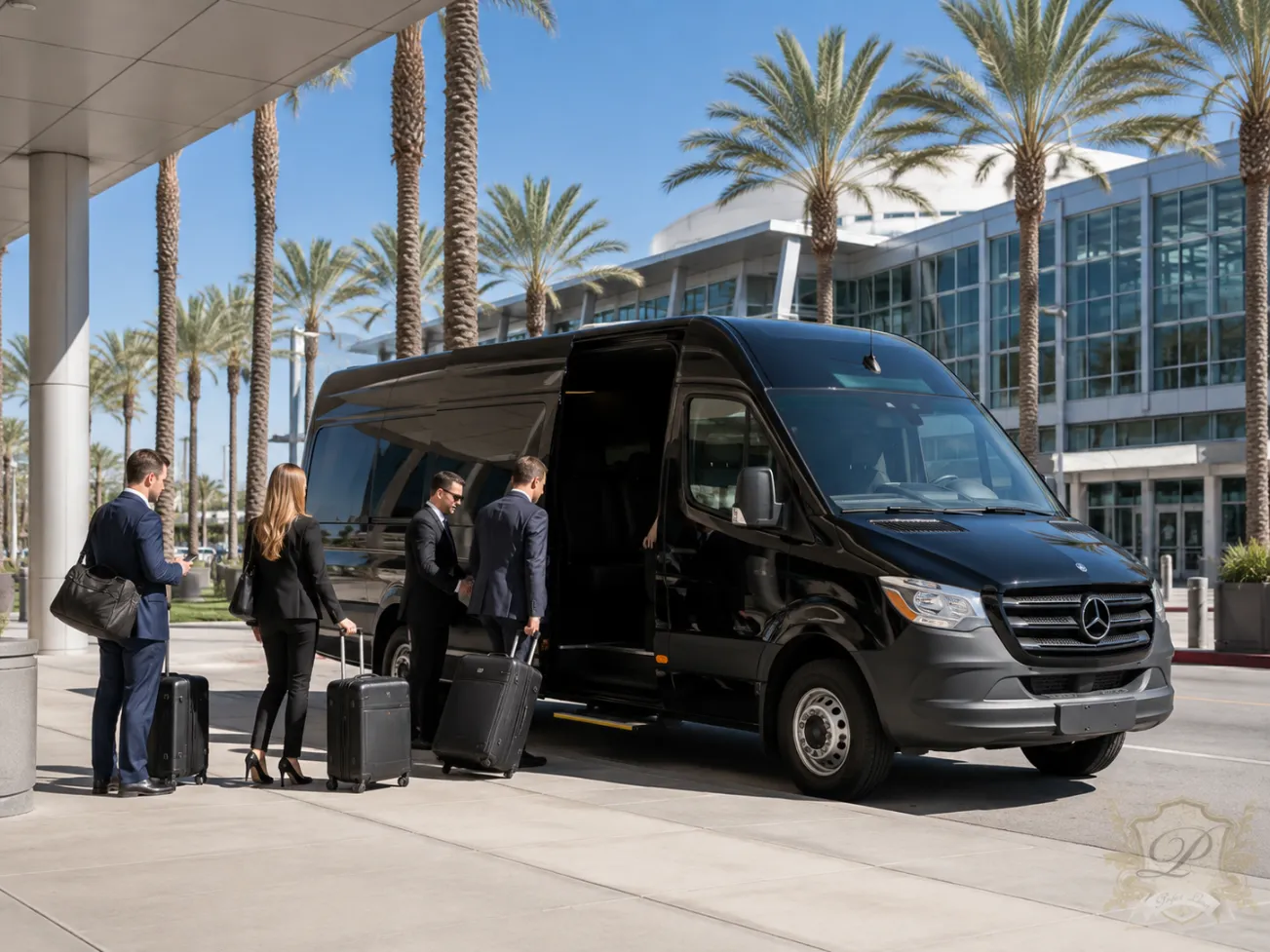
4. Client and Executive Transportation Is Also About the Experience
When an employee books transportation for himself, he may be comfortable making decisions as the trip unfolds. When a company is arranging transportation for someone else, expectations are different.
Consider a company inviting a prospective client to Southern California. The guest lands at ONT, travels to a hotel, attends meetings in Corona or Riverside the following morning, continues to a dinner in Orange County, then returns to the hotel. The transportation is now part of the hospitality experience.
In this scenario, the comparison between corporate transportation vs rideshare is less about whether either option is physically capable of completing the trips. The real question is whether the business wants each ride handled as a separate transaction or wants the transportation planned as part of the guest’s itinerary.
A planned sedan or SUV can also create a more consistent experience for a visiting executive. The traveler knows that transportation has already been addressed and can direct attention to the reason for the trip rather than making a new ground transportation decision at every stop.

5. Multi-Stop Business Days Favor Transportation Planning
Southern California business travel frequently crosses city and county boundaries. A professional may begin in Riverside County, attend an appointment in Orange County, continue to Los Angeles County, and return to the Inland Empire later that day.
Requesting individual rides can work when every segment is independent and the schedule has room for adjustment. A more complex itinerary benefits from looking at transportation as one continuous plan.
For example, an executive roadshow might require an airport pickup, hotel stop, two office visits, a lunch meeting, an evening event, and transportation back to the hotel. The important metric is not simply the time spent inside a vehicle. It is whether all of those movements support the day’s business objectives.
Companies evaluating transportation for a demanding schedule should therefore consider the wider principles of business travel efficiency, including how ground transportation affects the time available between flights, meetings, hotels, events, and other commitments.
6. Is Rideshare Cheaper Than Corporate Transportation?
Sometimes it can be. A short, uncomplicated rideshare trip may have a lower direct transportation cost than reserving a chauffeured vehicle. Businesses should not pretend otherwise.
The important distinction is between price and business value. The lowest individual fare is not necessarily the lowest-cost transportation strategy when a trip involves several employees, multiple vehicles, significant luggage, waiting between appointments, strict deadlines, or an important client experience.
A useful comparison should consider the complete itinerary. If four executives need two separate rideshare vehicles for several movements during a day, the company should compare that scenario against an appropriately sized vehicle and a planned transportation schedule. If only one employee needs an uncomplicated five-minute ride, the calculation may point in the other direction.
Compare the Whole Trip, Not Just One Fare
Evaluate the number of passengers, number of stops, luggage, required vehicle size, airport logistics, waiting time, schedule importance, client expectations, and whether several separate vehicles would otherwise be needed. That produces a more meaningful comparison than looking only at the first quoted trip price.
7. Why Southern California Makes Transportation Planning Different
Southern California is not one compact business district. Commercial activity is distributed across Los Angeles County, Orange County, Riverside County, San Bernardino County, and surrounding markets. Business travelers may also use several different airports depending on where meetings are located.
A trip involving Corona, Riverside, Ontario, Anaheim, Irvine, Los Angeles, or another regional business center can require substantial ground travel. Even when the map distance looks reasonable, the itinerary must account for when and where each movement occurs.
This regional layout is one reason why corporate transportation vs rideshare should be evaluated at the itinerary level. An app-based ride may be completely suitable for one isolated segment, while a scheduled chauffeured vehicle may make more operational sense for a day involving several cities or counties.
8. When Rideshare Is the Practical Choice
A fair comparison needs to recognize where rideshare performs well. Not every business trip requires a dedicated chauffeured vehicle.
Rideshare may be a practical option when one traveler needs a short trip, timing is flexible, there is no specific vehicle requirement, the passenger is comfortable managing the ride directly through an app, and the trip does not carry significant consequences if transportation plans change slightly.
Examples might include an employee traveling from a hotel to a nearby restaurant, an unscheduled personal errand between meetings, or an evening trip where no client, group, airport, or time-critical itinerary is involved.
Recognizing these situations makes the corporate transportation vs rideshare decision more useful. The goal is not to make professional transportation the answer to every trip. The goal is to use the appropriate transportation model for the importance and complexity of each trip.
9. When Corporate Transportation Is the Better Fit
Professional corporate transportation becomes increasingly valuable as the trip becomes more structured. This is particularly true when the company wants to arrange transportation before the traveler needs it rather than leaving each ground movement to be solved during the trip.
- Executive airport transfers connected to meetings or events
- VIP and client pickups where the company is responsible for the guest experience
- Multi-stop itineraries involving several business locations
- Corporate conferences and events with coordinated arrival requirements
- Team transportation where passengers need to remain together
- Luggage-heavy airport trips where selecting the correct vehicle matters
- Travel arranged by assistants or companies on behalf of another passenger
The more of these factors a trip includes, the stronger the case becomes for planning transportation as part of the business itinerary.
Corporate Transportation vs Rideshare: Which Should Your Company Choose?
Start with the importance of the trip. If the traveler simply needs convenient transportation and has flexibility, rideshare can be an efficient solution. If the transportation supports an important meeting, airport connection, executive schedule, client visit, corporate event, or group itinerary, professional corporate transportation provides a structure that is better aligned with those requirements.
| Business Scenario | Likely Better Fit |
|---|---|
| Quick trip from hotel to nearby restaurant | Rideshare |
| Executive landing at LAX with a scheduled meeting | Corporate transportation |
| Client pickup arranged by the hosting company | Corporate transportation |
| Flexible personal trip with no fixed arrival time | Rideshare |
| Six or more colleagues with luggage | Corporate group transportation |
| Multiple meetings across Southern California | Corporate transportation |
The best corporate travel programs can even use both. A company might reserve professional transportation for airports, executives, clients, groups, and complex itineraries while allowing employees to use rideshare for simple incidental travel. What matters is matching the transportation method to the business requirement.
Plan Business Transportation Before the Schedule Gets Complicated
The Perfect Limo and Sedan provides corporate and executive transportation throughout Southern California for airport transfers, business meetings, visiting clients, corporate groups, events, and multi-stop itineraries. Established in 2005, the company serves business travelers across the Inland Empire, Orange County, Los Angeles County, and surrounding Southern California destinations.
Planning an upcoming corporate trip? Review our corporate transportation options or call 800-951-3017 to discuss your itinerary and vehicle requirements.
Frequently Asked Questions About Corporate Transportation vs Rideshare
Is corporate transportation better than rideshare for business travel?
Corporate transportation is generally better suited to business-critical trips involving fixed schedules, executives, clients, airports, groups, multiple stops, or specific vehicle requirements. Rideshare can be more practical for simple and flexible trips where less advance coordination is needed.
Is rideshare always cheaper than corporate car service?
No. A short rideshare trip may cost less, but the total business transportation cost depends on factors such as group size, number of vehicles, number of stops, luggage, waiting requirements, and itinerary complexity. Companies should compare the complete trip rather than one individual fare.
Which is better for executive airport transportation?
Prearranged corporate transportation is often the stronger choice when an airport transfer connects to a meeting, hotel, event, client visit, or another time-sensitive commitment. It allows the transportation details and vehicle requirements to be addressed before the travel day.
Should companies use corporate transportation for clients?
It can be an effective choice when the company wants to coordinate the guest’s transportation as part of the overall visit. This is particularly useful for airport arrivals, hotel transfers, meetings, dinners, conferences, and multi-stop client itineraries.
Is corporate transportation better for groups?
It can be. A company can plan a vehicle around the number of passengers, luggage, itinerary, and destination instead of splitting a group among several unrelated rides. SUVs, executive vans, and Sprinters can be useful for larger business groups depending on the reservation requirements.
Can a business use both rideshare and corporate transportation?
Yes. Many transportation decisions are situational. Businesses can use scheduled corporate transportation for important airport transfers, executives, clients, groups, and complex itineraries while using rideshare for lower-complexity incidental trips.
What should I provide when booking corporate transportation in Southern California?
Provide the passenger count, pickup and destination details, schedule, flight information when applicable, luggage requirements, desired vehicle type, and any planned stops. Complex business itineraries should be discussed as a complete schedule so the transportation can be matched appropriately.
Final Takeaway
The decision between corporate transportation vs rideshare should reflect the importance of the trip. Rideshare provides valuable convenience for simple, flexible transportation. Corporate transportation adds a level of advance planning that becomes more useful as a business itinerary grows more important, more complex, or more dependent on coordinated timing.
For Southern California companies, executives, assistants, travel coordinators, and visiting professionals, the most effective approach is to identify which trips are merely transportation and which trips are part of the business operation itself. When the schedule, passenger, or outcome matters, planning the ground transportation in advance can be the smarter business decision.